
Vehicles with park-outside recalls don’t need to be running to pose a fire danger
The vehicle recalls highlighted in SRN are typically ones that most directly affect CR installation but recalls issued with park-outside warnings are also important for any CPS program to know about. In fact, a recent spike in this type of issue makes a case for checking a vehicle for recalls before ever allowing it to visit some checkup locations, like those inside a garage.
Recalls due to fire risk are not new, but they began to increase noticeably about ten years ago; in subsequent years, cases declined before spiking again in recent months. Today, Check to Protect estimates that there are over three million vehicles on the road with an active park-outside recall.
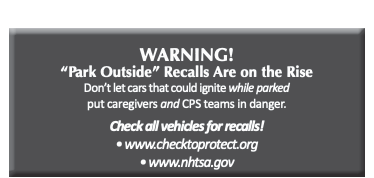
SRN has highlighted this issue before, including by posting a warning box like the one shown here. However, another major recall affecting tens of thousands of vehicles occurred in just the past month, prompting a full article on the topic.
What is a park-outside recall?
NHTSA assigns a “park outside” label to recalls when there is a risk that a vehicle may suddenly ignite, even when turned off and unattended. Because these recalls are urgent, NHTSA emphasizes this “park outside” designation at the beginning of the recall heading. Typically, the advice specifies an outdoor parking spot that is a safe distance from structures, other vehicles, or landscaping that could also burn if the vehicle catches on fire.
What vehicle types are prone to this problem?
Some vehicles from long ago had park-outside recalls, but the recent rise is due to the complex electronic systems in all modern vehicles. To be clear, this is not an issue exclusive to electric vehicles. Whether the engine is electric, hybrid, or combustion, virtually all modern cars have electronics that are called “always-on” (aka standby services), which can range from things as simple as clocks to more sophisticated features, like security systems and connected car services. While these systems aren’t the only cause of park-outside recalls, they make modern vehicles especially vulnerable to such problems.
What vehicle features cause the problem?
Unfortunately, there isn’t one specific culprit for these recalls that can be addressed. Instead, reasons vary widely.
For instance, earlier this year, two park-outside recalls by Volkswagen of its ID.4, an electric vehicle, were due to the vehicle’s high-voltage battery.
But many park-outside recalls are not related to a vehicle battery. For instance, in the case of the recent Hyundai/Genesis recall, as well as a recall of Kia Telluride, a fire can start when the seat control switch for a front power seat becomes stuck, causing its motor to overheat.
Another major recall this year of Jeep SUVs and pickups was caused by an electrical connection issue in the hydraulic power-steering pump wiring.
How CPSTs Can Lessen Risk of Park-Outside-Recall Vehicles
Many CPS activities occur around cars in covered garage spaces. Whether holding a car seat check event, hosting a regular inspection station, or conducting a certification training, it would be extremely dangerous for a nearby vehicle to suddenly ignite. Keep activities safe by planning ahead:
- At CR checkups: Always check vehicles, as well as CRs, for recalls. (See the box, left, for look-up sites.) This doesn’t mean caregivers whose vehicles have recalls should be turned away, but they should be advised about the risk and directed to park outdoors for the checkup.
- For certification courses: Ask tech candidates and instructors to check their vehicles for recalls before attending class and park any recalled vehicles accordingly.
- For public outreach: Consider this topic for public safety campaigns, especially in certain states. CARFAX says there are over 600,000 affected vehicles in California and Texas alone; Florida, Ohio, Pennsylvania, New York, Georgia, North Carolina, and Illinois each have over 100,000 such cars.