
Ohio State University (OSU) and Children’s Hospital of Philadelphia have released a series of videos to teach caregivers about the dangers of CR misuse. Support was provided by the National Safety Council and Evenflo.
Each of the eight short videos focuses on a common CR misuse. Together, they could be called the “Importance Of” series, as each title starts with “Importance of” and is followed by these specific aspects of CR use:
- Tight installation: Rear-facing car seat
- Snug harness: Rear-facing car seat
- Tight installation: Forward-facing car seat
- Snug harness: Forward-facing car seat
- Tether: Forward-facing car seat
- Booster seats
- Correct booster seat use: Incorrect seat belt placement under arm
- Correct booster seat use: Incorrect seat belt placement behind back
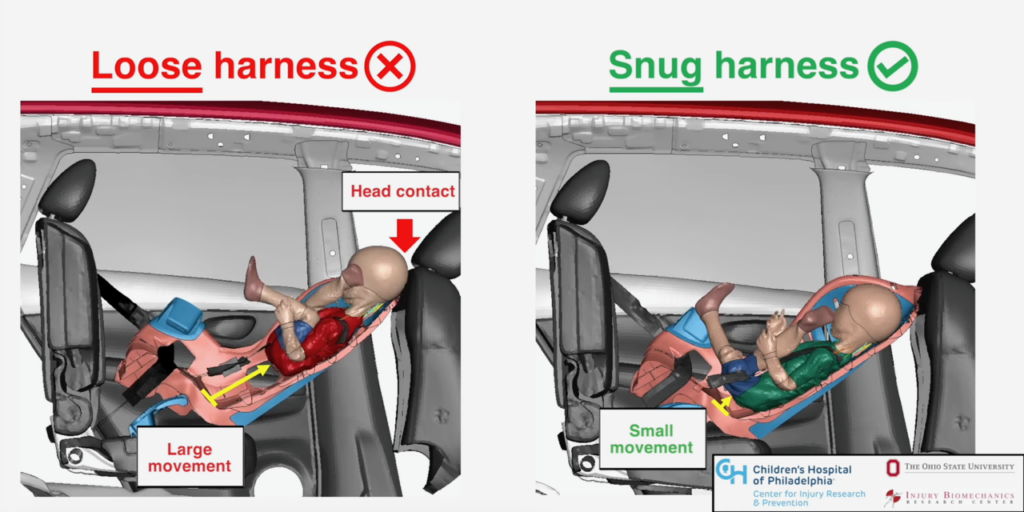
The videos start with a mockup of a type of misuse, using a doll in a sample CR, and demonstrate how to correct the misuse. For instance, harness-use videos show a harness that’s too loose, how to make the harness snug by pulling the harness adjuster strap, and how to check for proper snugness using the pinch test.
Then, during the later portion of the videos, finite element modeling techniques were used to show side-by-side crash outcomes for child passengers in CRs with and without the specific form of misuse. The crashes are in slow motion, and text overlays call out points of particular note during the crash sequence.
A narrator (CPST Julie Mansfield, one of the two researchers, along with Jalaj Maheshwari) provides a simple description of the misuse, corrections, and crash scenarios. The series is scripted and presented in English using easy-to-understand language. Although each video element is covered slowly and clearly, most of the videos have a run time of just a little more than a minute.
The videos are meant to provide the “why” behind key CR usage advice. To ensure the videos’ accuracy, the project team enlisted CPSTs last summer to preview the videos and provide feedback on all aspects of the content.
The topics and format of the videos make them an excellent tool for teaching the public about CPS; for instance, they can be shown on a loop at safety fairs or hospital information stations. They would also be an excellent supplement to curbside education during a checkup.
Find the free videos at OSU’s Buckle Up With Brutus YouTube channel at https://www.youtube.com/@buckleupwithbrutus.